


What is drug-induced amnesia?
Drug-induced amnesia is a pharmacologically caused memory impairment, most commonly the inability to form new memories after taking a substance. Clinically, it divides into two forms: anterograde amnesia, where a person cannot encode new information after drug exposure, and retrograde amnesia, where recall of events before exposure becomes partial or fragmented. A 2026 IJPS Journal review confirms that anterograde amnesia is the dominant presentation, caused by medications including benzodiazepines, anticholinergics, hypnotics, anticonvulsants, and anesthetics.
The impairment is not random. It follows a dose-response pattern: higher doses and more medications taken together produce greater cognitive disruption. This matters because many people taking multiple prescriptions may not connect their forgetfulness to their medication cabinet.
Key characteristics to understand:
- Anterograde amnesia: inability to form new memories during or after drug exposure
- Retrograde amnesia: partial loss of memories formed before drug exposure
- Reversibility: often resolves when the causative drug is reduced or stopped
- Dose-response relationship: cognitive effects worsen as dose or number of medications increases
- Primary drug classes involved: benzodiazepines, anticholinergics, Z-drugs (hypnotics), anticonvulsants, opioids, tricyclic antidepressants, anesthetics, and corticosteroids
Table of Contents
- Which medications are most likely to affect your memory?
- How drug-induced amnesia disrupts memory formation
- How do you tell the difference between medication side effects and dementia?
- Managing drug-induced amnesia: deprescribing and supportive care
- What recovery looks like after drug-induced amnesia
- How to reduce your risk of medication-related memory loss
- Key Takeaways
- FAQ
Which medications are most likely to affect your memory?
Several drug classes carry meaningful risk for medication memory loss, and understanding them helps you ask the right questions at your next appointment.

Benzodiazepines (alprazolam, diazepam, lorazepam) dampen activity in brain regions responsible for transferring events from short-term to long-term memory. They are intentionally used in anesthesia for this property, but the same mechanism operates at therapeutic doses for anxiety.
Z-drugs (zolpidem, zaleplon, eszopiclone) act on many of the same brain pathways as benzodiazepines. They can trigger amnesia and sometimes produce dangerous behaviors, such as driving or cooking with no memory of the event upon waking, according to AARP’s clinical review.
Anticholinergics block acetylcholine, the neurotransmitter central to memory and learning. This category spans bladder medications, first-generation antihistamines, and some antidepressants. Risk compounds when multiple anticholinergic drugs are taken together or used long-term.
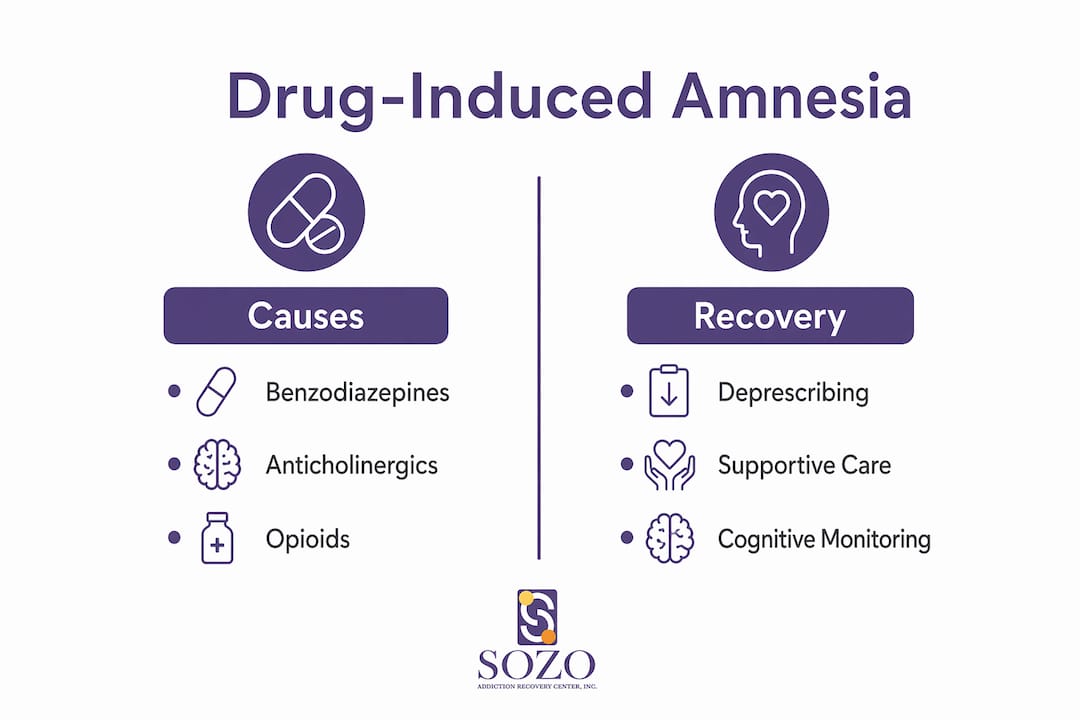
Opioids interfere with both short- and long-term memory by disrupting chemical messengers involved in cognition. Extended use carries particular concern, with research linking opioid use to dementia risk in older adults.
Tricyclic antidepressants block serotonin, norepinephrine, and related messengers, producing memory lapses as a recognized side effect. Anticonvulsants slow central nervous system signaling broadly, with drowsiness, attention problems, and memory difficulty as common consequences. Corticosteroids at high doses can cause confusion and memory disruption, and even some over-the-counter heartburn medications have been associated with cognitive risk in longer-term use.
Polypharmacy amplifies all of these risks. When overlapping pharmacological pathways are affected simultaneously, the cumulative burden on cognition grows substantially, a pattern the Canadian Deprescribing Network and AARP both flag as underappreciated.
How drug-induced amnesia disrupts memory formation
The brain does not store memories in a single location. Episodic memory, the kind that records personal experiences and recent events, depends heavily on the hippocampus and amygdala. Benzodiazepines, for example, act on GABA-A receptors in these structures, producing rapid-onset anterograde amnesia by suppressing the neural activity needed to bind new information into lasting form.
The impairment is selective, not total. Research on midazolam shows that familiar verbal memories are more vulnerable than pictorial or abstract ones, because verbal recall relies on episodic binding that drugs disrupt most readily. A person may recognize a face but not recall a recent conversation. Procedural memory, the kind that governs learned skills, tends to remain more intact.
Statistic callout: Polypharmacy with three or more cognitive-impacting medications increases memory loss risk by 1.5 to 3 times compared to people taking none of those medications, based on large population studies showing dose-dependent cumulative effects.
Short-term memory suffers first, with disrupted attention and processing speed. Long-term memory consolidation fails when the encoding stage is chemically blocked. The result is a person who functions normally in familiar routines yet has significant gaps in recent experience, which can feel disorienting and frightening without a clear explanation.
How do you tell the difference between medication side effects and dementia?
This distinction matters more than most people realize, and it is frequently missed. Drug-induced memory impairment is often a reversible functional state, not permanent brain damage. Dementia, by contrast, involves progressive neurodegeneration that no medication adjustment will undo. Mayo Clinic notes that even approved Alzheimer’s medications manage symptoms rather than cure the underlying disease, which underscores why correctly identifying a reversible, drug-related cause is so consequential.
Several clinical features help distinguish the two:
- Onset pattern: medication-related cognitive decline often correlates with starting a new drug or increasing a dose; dementia progresses gradually and independently
- Reversibility: memory typically improves after reducing or stopping the causative medication; dementia does not reverse
- Cognitive testing: standardized assessments like the Montreal Cognitive Assessment (MoCA) can track change over time and inform differential diagnosis
- Medication history: a complete list of all prescriptions, over-the-counter drugs, and supplements is the starting point for any accurate evaluation
- At-risk populations: older adults are especially vulnerable because aging slows drug metabolism, raising effective drug concentrations; people already living with mild cognitive impairment face compounded risk
Individuals with dementia diagnoses should be particularly careful, as medications that worsen cognition can accelerate functional decline even when the underlying disease is the primary driver. A thorough medication review is not optional in these cases.
Managing drug-induced amnesia: deprescribing and supportive care
The most evidence-supported strategy for reversing medication-related cognitive decline is deprescribing: the supervised reduction, tapering, or elimination of drugs contributing to memory impairment. This is not simply stopping a medication. It requires a coordinated plan with a prescribing clinician, pharmacist, or specialist who can weigh the risks of discontinuation against the cognitive burden of continuing.
Practical steps for managing this process:
- Request a full medication review from your doctor, nurse, or pharmacist, bringing every medication including OTC products and supplements
- Ask specifically about deprescribing: “Could any of my medications be affecting my memory, and could the dose be reduced?”
- Never stop abruptly. Benzodiazepines and antidepressants require gradual tapering to avoid withdrawal complications including seizures and severe confusion
- Switch drug classes when possible: a clinician may identify an alternative medication with fewer cognitive side effects
- Monitor cognitive function before and after any medication change to document improvement
Pro Tip: Never taper benzodiazepines or antidepressants on your own. Abrupt discontinuation can trigger seizures and acute withdrawal. A medically supervised tapering schedule, adjusted to your history and current dose, is the only safe path.
Supportive care alongside deprescribing includes cognitive monitoring, counseling to address the emotional weight of memory gaps, and structured daily routines that reduce cognitive demand during recovery. For men whose substance use has intersected with prescription medication misuse, centers like Sozorecoverycenter offer dual diagnosis treatment that addresses both the clinical and spiritual dimensions of healing.
What recovery looks like after drug-induced amnesia
Prognosis is generally favorable when the causative medication is identified and appropriately managed. Most people notice meaningful improvement in memory and clarity within days to weeks of reducing or stopping the offending drug, though the timeline varies by substance, duration of use, and individual health factors.
Benzodiazepine-related cognitive effects can linger for weeks to months after discontinuation, particularly with long-term use. Anticholinergic-related impairment may take longer to clear, and in some older adults, prolonged use has been associated with risk that persists beyond cessation. Opioid-related cognitive effects often improve substantially once use stops, though co-occurring mental health conditions can complicate recovery.
Full cognitive recovery is more likely when the drug was taken for a shorter period, at lower doses, and without significant polypharmacy. Age, baseline cognitive health, and the presence of any underlying neurological condition all influence the outcome. The encouraging truth is that for many people, what felt like the beginning of dementia turns out to be a medication effect that lifts once the right adjustments are made.
How to reduce your risk of medication-related memory loss
Prevention begins with awareness and honest communication with your care team. A few consistent practices make a meaningful difference:
- Maintain a single, updated medication list including all prescriptions, OTC drugs, vitamins, and herbal supplements, and bring it to every appointment
- Ask about the lowest effective dose for any new prescription; higher doses carry proportionally higher cognitive risk
- Avoid combining medications with overlapping cognitive pathways without explicit clinical guidance
- Limit or avoid alcohol while taking sedatives, benzodiazepines, or opioids, as alcohol amplifies amnestic effects significantly
- Schedule periodic medication reviews, especially after any new prescription is added or after turning 65
- Be cautious with long-term OTC use: even common antihistamines and antacids carry cumulative anticholinergic burden with extended use
- Recognize early warning signs: new forgetfulness, confusion, or unusual behavior after starting a medication warrants prompt conversation with your provider, not a wait-and-see approach
For men navigating substance use and cognitive recovery, building these habits into a broader recovery plan, one that includes clinical care, community, and faith, creates a foundation that holds.
If you or someone you care about is struggling with the cognitive and emotional effects of substance use or prescription medication misuse, Sozorecoverycenter in Hot Springs, Arkansas offers faith-based rehab that integrates clinical dual diagnosis care with spiritual renewal. Recovery is not just possible. It is the beginning of something better.
Key Takeaways
Drug-induced amnesia is most often a reversible, medication-caused impairment of new memory formation that responds to supervised deprescribing and clinical management.
| Point | Details |
|---|---|
| Anterograde amnesia is primary | Most drug-induced memory loss affects the ability to form new memories, not erase old ones. |
| Polypharmacy multiplies risk | Taking three or more cognitive-impacting medications raises memory loss risk by 1.5 to 3 times. |
| Reversibility distinguishes it from dementia | Memory typically improves after reducing the causative drug; dementia does not reverse with medication changes. |
| Tapering must be supervised | Abrupt cessation of benzodiazepines or antidepressants can cause seizures; gradual tapering is required. |
| Prevention starts with communication | A complete, updated medication list shared at every clinical visit is the single most effective preventive step. |
FAQ
What drugs most commonly cause amnesia?
Benzodiazepines, Z-drugs (zolpidem, zaleplon), anticholinergics, opioids, anticonvulsants, and anesthetics are the most frequently implicated, according to the 2026 IJPS Journal review. Polypharmacy, taking several of these together, significantly amplifies the risk.
Is drug-induced amnesia permanent?
In most cases, no. Drug-induced amnesia is typically a reversible functional state that improves once the causative medication is reduced or stopped under medical supervision. Long-term or high-dose use of certain drugs, particularly anticholinergics, may carry more persistent effects in older adults.
How is medication-related memory loss diagnosed?
Diagnosis involves a complete medication history, cognitive testing such as the MoCA, and clinical observation of whether memory changes correlate with medication use. Providing your provider with a full list of all medications, including OTC products, is the essential first step.
Can stopping a medication suddenly restore memory faster?
No. Abrupt discontinuation of benzodiazepines or antidepressants can cause dangerous withdrawal, including seizures. A supervised tapering plan is the safe and effective approach, and cognitive improvement typically follows gradually over days to weeks.
Who is most at risk for drug-induced cognitive effects?
Older adults face the highest risk because aging slows drug metabolism, raising effective drug concentrations in the body. People with existing cognitive impairment, those taking multiple medications, and individuals combining prescription drugs with alcohol are also particularly vulnerable.