


Yes, most rehabs allow smoking, but almost never freely. A national facility survey found that 67.8% of residential programs permit smoking only in designated outdoor areas, not indoors or on demand. Exact rules depend on the state and the facility, so confirm the policy before you pack a single pack of cigarettes.
TL;DR:
- Most rehab facilities permit outdoor smoking only during scheduled breaks and under supervision, not freely or indoors, with policies varying by state and facility.
- State laws significantly influence treatment centers’ smoking policies, with some requiring complete tobacco bans and others mandating cessation services alongside permitted smoking.
- Facilities often implement tapering protocols, restrict vaping and marijuana, and confiscate unsealed products or unapproved items to control nicotine and substance use on-site.
- Quitting smoking during addiction treatment does not hinder recovery and is linked to improved mental health and better long-term outcomes.
Table of Contents
- Are You Allowed to Smoke in Rehab?
- How State Laws Shape What Your Facility Can Allow
- How Facilities Actually Run Smoking Policy Day to Day
- What Cessation Support Looks Like, and Why Quitting Now Might Help
- Questions to Ask Admissions Before You Arrive
- SOZO’s Approach to Tobacco in Treatment
- Ready to Ask Admissions Directly?
- Sources
- FAQ
Are You Allowed to Smoke in Rehab?
The short answer is “usually, with limits.” Indoor smoking is essentially gone from American treatment centers, and what remains is a patchwork of outdoor windows, time restrictions, and staff oversight that varies from one facility to the next.
That outdoor pattern holds across most of the country. The same national sample found 52.1% of outpatient facilities use the same designated area model, which tells you this is not an isolated quirk of residential care. It is the dominant approach nationwide.
Here’s what that typically looks like on the ground:
- Smoking is confined to a marked outdoor patio, courtyard, or smoking shelter, usually kept a set distance from building entrances.
- Access is scheduled, not open. Many programs allow smoking only during set breaks, not whenever a craving hits.
- Staff often supervise the area, partly for safety and partly to prevent trading, hoarding, or unauthorized substances entering through a “smoke break.”
- Visitors and staff are frequently held to the same outdoor rule as clients, so nobody smokes near the entrance while a resident stands ten feet away unable to do the same.
This model exists partly because of history. Some programs once tolerated smoking as a stand-in for harder substances, treating it as the lesser evil during early recovery. That thinking has shifted. Facilities that actively screen for tobacco use and offer cessation treatment tend to run tighter smoking policies overall, which suggests the old harm-reduction logic is losing ground to a more direct approach: treat the nicotine dependence alongside everything else.
Pro Tip: Call admissions and ask them to read you the actual written smoking policy, not just summarize it. “We’re mostly outdoor” can mean five smoke breaks a day or one.
How State Laws Shape What Your Facility Can Allow
There is no single national rule dictating smoking policy in addiction treatment. Congress has not set one, and the CDC’s tracking of tobacco-free behavioral health facilities shows wide variation instead of a uniform standard. What you’re allowed to do depends heavily on where the facility sits.
States take genuinely different approaches:
- Some states require licensed behavioral health facilities to maintain fully tobacco-free grounds, meaning no smoking anywhere on campus, indoors or out.
- Others mandate that any facility permitting smoking must also offer tobacco cessation services, pairing restriction with support rather than restriction alone.
- Many states simply extend general indoor clean-air laws to treatment centers and leave outdoor policy to the facility’s discretion.
New York’s health authority, for example, publishes detailed operational guidance for facilities that still permit limited smoking, spelling out exactly how outdoor access and tapering should work. That level of detail does not exist everywhere, and a facility two states over might be governed by a completely different framework.
Peer-reviewed research on this variability confirms the pattern is real, not anecdotal: smoking policy stringency differs significantly by state and facility type. If a specific state’s rule matters to your decision, ask the facility directly which regulations govern them and request the written policy rather than relying on general assumptions.
How Facilities Actually Run Smoking Policy Day to Day
Policy on paper and policy in practice are two different things. Here is how the mechanics typically play out inside a facility that permits limited smoking:
- Tapering by intake level. Some programs assign a tapering level at admission, often ranging from zero to four, with each level tied to a daily cigarette allotment and a scheduled window, sometimes five minutes, for supervised smoking. Clients who decline tapering are still treated for tobacco use disorder and may lose smoking privileges during the early admission period.
- Sealed packaging and staff-controlled lighters. Facilities following guidance similar to New York’s tapering framework often require cigarette packs to stay sealed until distributed, with staff holding lighters rather than clients carrying their own.
- Restricted vaping. Vape devices get treated with more suspicion than cigarettes because they can be modified to conceal other substances, and a resealed pod is far easier to disguise than a pack of cigarettes.
- Marijuana stays off campus almost everywhere. Even in states where recreational or medical use is legal, treatment facilities generally prohibit it on-site, since campus policy and state consumer law are not the same thing.
Confiscation and holding procedures round out the system. Anything that arrives unsealed, unlabeled, or outside the approved list typically gets held by staff until discharge, not destroyed, which matters if you’re bringing a nicotine product tied to a medical prescription.
What Cessation Support Looks Like, and Why Quitting Now Might Help
Facilities that go tobacco-free rarely leave clients to grit their way through withdrawal alone. Among facilities with a tobacco-free policy, 81.8% offer at least one cessation service, pairing the restriction with actual clinical support rather than a bare rule.
That figure comes with a caveat worth knowing before intake: fewer than half of facilities nationally offer pharmacotherapy for cessation, meaning counseling is far more universally available than medication. If quitting nicotine is part of your plan, ask specifically whether medication is on the table, not just talk therapy.
Common cessation supports include:
- Individual or group behavioral counseling focused on cravings, triggers, and relapse prevention specific to nicotine.
- Nicotine replacement therapy through patches, gum, or inhalers, which NIDA identifies as an evidence-based option for managing withdrawal.
- Prescription medications such as varenicline or bupropion, generally considered most effective when combined with counseling rather than used alone.
The bigger question for most men walking into treatment is whether quitting smoking now will sabotage progress on the primary addiction. Research summarized by NIH says the opposite: quitting smoking during treatment for another substance use disorder does not impede that recovery and is linked to better mental health and stronger long-term outcomes. If you’ve been telling yourself “one addiction at a time,” the data doesn’t back that instinct.
Questions to Ask Admissions Before You Arrive
A five-minute phone call before intake saves a lot of frustration on day one. Bring these questions to admissions:
- Is smoking permitted anywhere on campus, and if so, where and how often?
- Are vaping or marijuana treated differently from cigarettes, and is either banned outright?
- Does the program offer nicotine replacement therapy or prescription cessation medication?
- Is there a tapering protocol, and what happens if I choose not to participate?
- What items should I pack, and what needs to stay home? Check the facility’s packing guidance for specifics on sealed packaging and prohibited items.
If quitting nicotine cold isn’t realistic for you right now, say so during intake. Most programs would rather build a plan around your actual starting point than have you white-knuckle it through week one.
SOZO’s Approach to Tobacco in Treatment
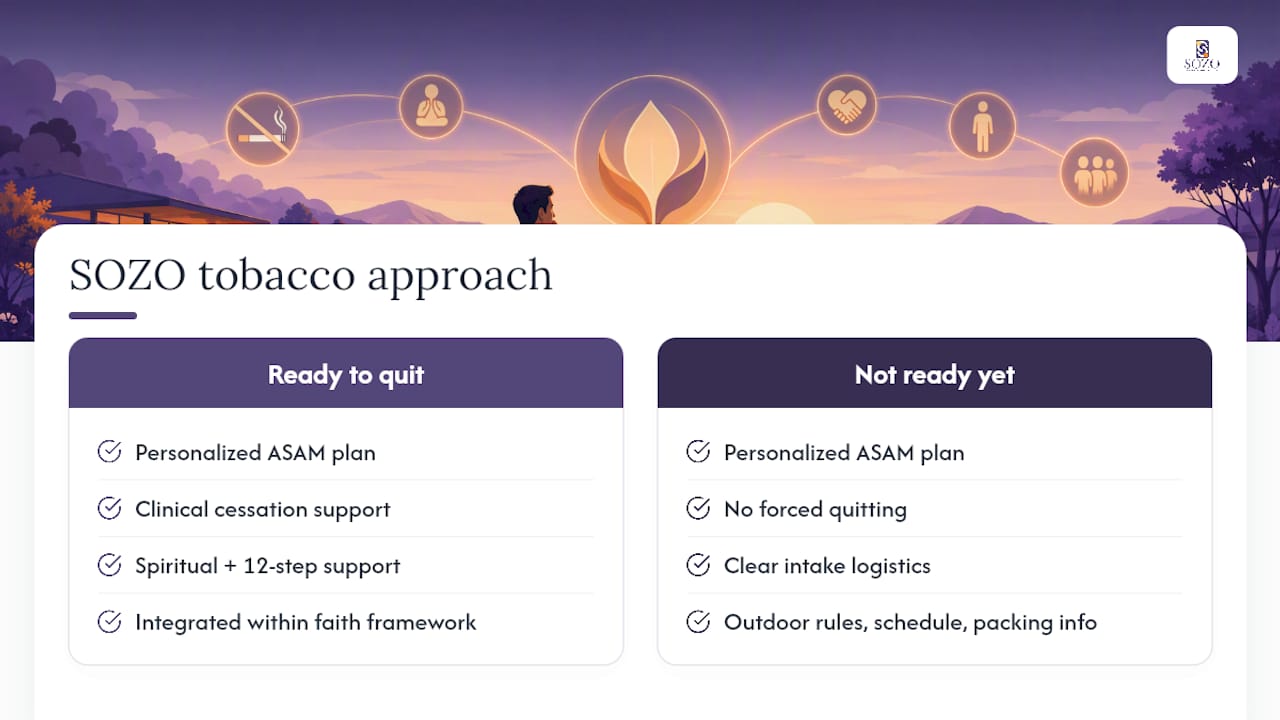
At Sozorecoverycenter, tobacco use gets addressed the same way everything else does: as part of a personalized plan built on the ASAM Continuum, not a blanket rule applied without context. A man arriving nicotine-dependent and ready to quit gets a different plan than a man who isn’t there yet, and both plans sit inside the same faith-based framework that treats the whole person, not just the presenting addiction.
For men who want to quit, that means clinical support paired with the spiritual and 12-step structure already built into the program. For men who aren’t ready, intake logistics focus on clarity rather than surprise. You’ll know the outdoor rules, the schedule, and what to pack before you walk through the door, so tobacco policy never becomes the reason a first day in treatment gets derailed.
Ready to Ask Admissions Directly?
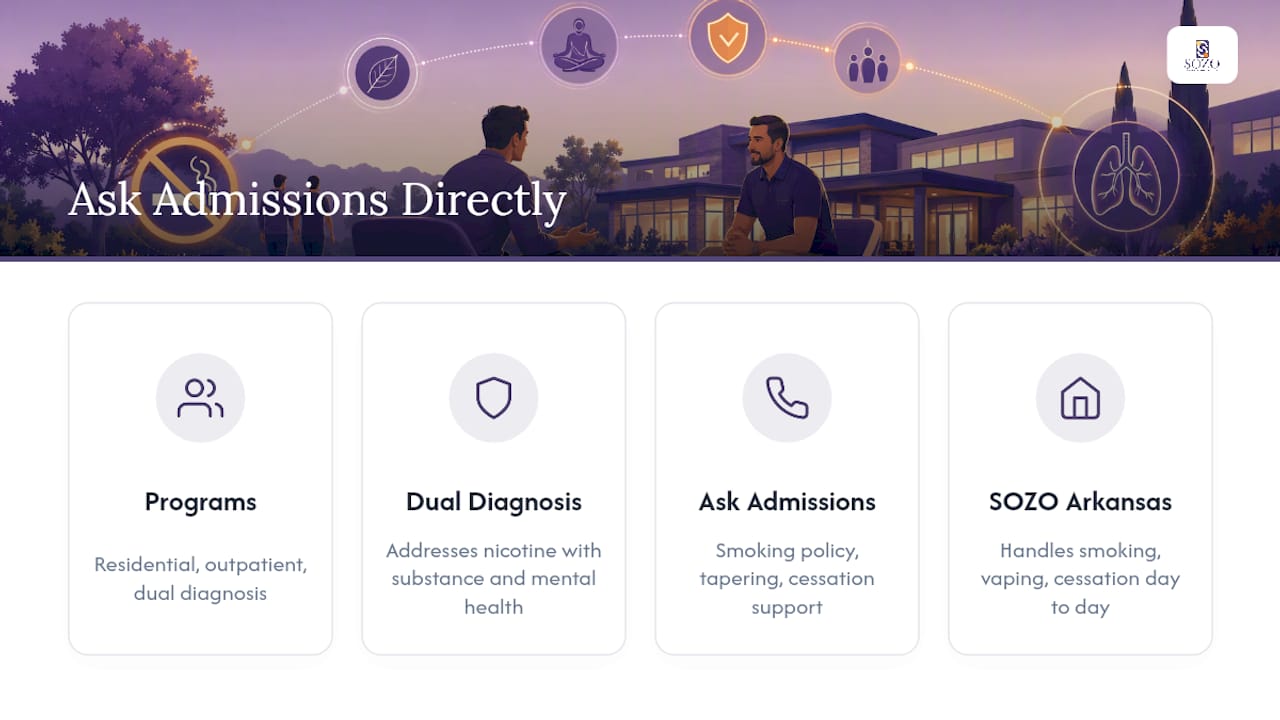
A treatment center runs residential, outpatient, and dual diagnosis programs for men, and admissions can walk you through exactly how tobacco fits into your specific treatment plan before you pack a bag.
If nicotine is part of the picture alongside a primary substance or a co-occurring mental health concern, the dual diagnosis program is built to address both at once rather than treating tobacco as an afterthought. Men choosing a program built specifically around male recovery often find that structure matters as much as any single policy detail, and admissions can explain how SOZO’s faith-based residential treatment in Arkansas handles smoking, vaping, and cessation support day to day. For readers weighing whether faith-based spiritual support fits their recovery goals, resources like Addiction Spiritual Support Working can round out that picture before you commit.
Reach out to SOZO admissions today with your specific questions about smoking policy, tapering options, or cessation support. Getting a straight answer before intake means one less unknown on your first day of treatment.
This article is general information, not a substitute for advice from a qualified doctor. Consult a qualified healthcare professional about your own circumstances before acting on anything here.
Sources
- Smoking Policies of Outpatient and Residential Substance Use Disorder Treatment Facilities in the United States – PMC
- Tobacco-Related Clinical Services and Tobacco-Free Policies in Behavioral Health Treatment Facilities — United States, 2023
- OASAS limited tobacco guidance (NY)
- Quitting smoking associated with recovery from other addictions – NIH News
FAQ
Are people in rehab allowed to smoke?
Most facilities allow smoking in some limited form, usually restricted to a designated outdoor area on a set schedule, but a growing number of state-regulated programs require fully tobacco-free grounds.
What is the 3-3-3 rule for smoking?
There’s no established clinical or regulatory “3-3-3 rule” for smoking in addiction treatment; if you’ve seen that term, it’s likely referring to a specific facility’s internal tapering schedule rather than a national standard, so ask admissions directly if you’ve encountered it.
What is not allowed in rehab?
Rules vary by facility, but common restrictions include unsealed cigarette packs, personal lighters, vape devices (which can be modified to conceal other substances), and marijuana, even in states where it’s legally available outside treatment.
What are the smoking laws in North Carolina?
Smoking laws and facility-specific tobacco policies differ by state and by individual treatment center; readers in North Carolina should confirm current rules directly with the facility or the state’s behavioral health licensing authority rather than relying on general assumptions.
Does quitting smoking during rehab hurt my recovery from other addictions?
No. Research summarized by NIH found that quitting smoking during treatment for another substance use disorder supports rather than harms recovery, with better mental health outcomes reported among those who quit.