


Dual diagnosis means a person has both a mental health disorder and a substance use disorder happening at the same time. One of the most common dual diagnosis examples is major depressive disorder paired with alcohol use disorder. When that happens, both conditions need treatment together, not one after the other, because treating only one usually leaves the door open for relapse.
TL;DR:
- Most dual diagnoses involve conditions where one disorder creates vulnerability for the other, such as depression with alcohol use disorder or PTSD with opioid misuse.
- Symptoms often overlap or mask each other, making accurate diagnosis difficult without a comprehensive evaluation from multiple healthcare providers.
- Effective treatment requires integrated, coordinated care that addresses both mental health and substance use disorders simultaneously, rather than sequentially.
- Barriers like insurance limitations, stigma, diagnostic complexity, and limited access in rural areas hinder proper treatment; deliberate program selection and asking about coordination can help.
- Long-term recovery depends on continuous support, medication management, peer involvement, family participation, and ongoing mental health care, acknowledging the chronic nature of dual disorders.
Table of Contents
- Common Dual Diagnosis Examples You Should Know
- How Co-Occurring Disorders Change Symptoms and Risk
- Why Dual Diagnosis Happens: Causes and Risk Factors
- What a Dual Diagnosis Assessment Actually Involves
- Treatment for Co-Occurring Disorders: Why Integration Matters
- Finding Help for Dual Diagnosis: Where to Start
- The Real Barriers to Treating Dual Diagnosis
- What Long-Term Recovery From Dual Diagnosis Looks Like
- How Dual Diagnosis Reaches Into Every Part of Life
- A Perspective From SOZO Recovery Center
- Faith-Based Dual Diagnosis Care for Men at SOZO
- Sources
- FAQ
Common Dual Diagnosis Examples You Should Know
Certain pairings show up again and again in clinical practice, and each one follows a logic you can actually trace. A man doesn’t wake up one day with two unrelated problems. Usually, one condition creates fertile ground for the other, and over time they start feeding each other.
- Major depressive disorder and alcohol use disorder. Alcohol depresses the central nervous system, which can deepen an existing depressive episode even as it temporarily numbs it.
- Anxiety disorders and prescription drug misuse. Benzodiazepines like Xanax or Ativan work fast on panic symptoms, which makes them easy to lean on and hard to stop.
- PTSD and opioid use disorder. Opioids blunt both physical pain and the emotional flashback loop that trauma survivors live with, which is part of why this pairing is so common among veterans and survivors of violence.
- Bipolar disorder and stimulant misuse. Cocaine or methamphetamine can mimic or intensify manic energy, and a man in a depressive phase of bipolar disorder may reach for stimulants just to feel functional again.
- Schizophrenia and cannabis use disorder. Heavy cannabis use is linked with earlier onset and worse course of psychotic symptoms in people already vulnerable to schizophrenia.
- Eating disorders and alcohol or stimulant misuse. Stimulants suppress appetite and alcohol numbs the shame cycle, so both substances can become tangled up with disordered eating behaviors.
Picture a combat veteran who can’t sleep without a pill and can’t get through the day without a drink to quiet the memories. That’s PTSD and opioid use disorder playing out in real time, not a textbook case. These clinical examples of dual diagnosis are illustrative, not an exhaustive list. The DSM-5-TR frames co-occurrence broadly, and any combination of a mental health condition and a substance use disorder qualifies.
How Co-Occurring Disorders Change Symptoms and Risk
Symptoms of dual diagnosis rarely stay in separate lanes. Withdrawal from alcohol can look identical to a panic attack. Stimulant crash can mimic clinical depression so closely that a doctor unfamiliar with the substance use history might misdiagnose it entirely. That overlap is exactly why one disorder tends to mask, mimic, or worsen the other, and why the two conditions escalate together instead of on parallel, independent tracks.
Left unaddressed, this cycle bleeds into every corner of a man’s life: missed workdays, strained marriages, legal trouble, and mounting debt. The physical risk is just as real.
In 2024, roughly 1 in 3 people who died from an overdose had a diagnosed mental health condition like depression, anxiety, or bipolar disorder, according to the CDC. That statistic is not a footnote. It’s a direct argument for treating both conditions at once, not sequentially.
Why Dual Diagnosis Happens: Causes and Risk Factors
Three pathways explain most co-occurring disorders. Self-medication happens when someone uses alcohol or drugs to quiet anxiety, insomnia, or depression they haven’t named yet. Substance-induced disorders happen in reverse, when heavy or prolonged use actually triggers a mental health condition that wasn’t there before. Shared vulnerability covers cases where trauma, genetics, or chronic stress raise the risk for both conditions independently.
- Childhood trauma or combat exposure
- Family history of addiction or mental illness
- Chronic stress, poverty, or unstable housing
- Early access to alcohol or prescription medication
Protective factors, like stable relationships, steady routines, and early intervention, cut that risk substantially. The earlier a man gets an honest assessment, the shorter the road back.
What a Dual Diagnosis Assessment Actually Involves
A proper evaluation usually involves more than one clinician, since a psychiatrist, an addiction specialist, and sometimes a primary care doctor each catch things the others might miss. Clinicians rely on DSM-5-TR criteria, structured screening tools, and a detailed substance use timeline to separate a substance-induced disorder from an independent mental health condition, since that distinction directly shapes treatment.
Before an intake appointment, it helps to bring:
- A timeline of when mental health symptoms and substance use each started
- A list of prior treatments, medications, and hospitalizations
- Details on any recent overdose, blackout, or crisis episode
- Questions about how the provider integrates mental health and addiction care
Treatment for Co-Occurring Disorders: Why Integration Matters
Integrated treatment means mental health care and addiction care happen under one coordinated plan, delivered by a team that talks to each other, not two separate providers working in silos. SAMHSA recommends this approach specifically because co-occurring conditions respond poorly to fragmented care, and the NIMH points to integrated care as the model most consistently linked to better long-term outcomes.
Evidence-based dual diagnosis treatment typically draws from a defined toolkit:
- Cognitive behavioral therapy to interrupt distorted thought patterns feeding both conditions
- Motivational interviewing to build a man’s own reasons for change rather than imposing them
- Contingency management, which reinforces sobriety with tangible incentives
- Trauma-focused therapies for men whose substance use traces back to PTSD or abuse
- Medication-assisted treatment for opioid use disorder, alongside psychiatric medication for mood or psychotic disorders when clinically appropriate
Care happens across a range of settings, from residential programs for men who need round-the-clock structure, to intensive outpatient or standard outpatient care for those stepping down or managing lighter symptoms. The right level of care depends on severity, safety risk, and how much daily structure a person actually needs, which is part of what the ASAM Continuum model is built to assess.
Pro Tip: Don’t treat detox as the finish line. Detox addresses the body’s physical dependence, but without a mental health follow-up plan already in place, the underlying condition that drove the substance use in the first place is still waiting on the other side.
Finding Help for Dual Diagnosis: Where to Start
If someone is in crisis, in active withdrawal, or has recently overdosed, that’s an emergency room or crisis line situation first, treatment planning second. Once stable, a primary care visit is often the fastest way into the system.
- Ask a primary care doctor directly for a referral to an integrated dual diagnosis program, not just an addiction program or a therapist alone.
- Bring your symptom and substance use timeline to the first appointment.
- Search Findtreatment, the federal treatment locator, and filter for programs that explicitly list co-occurring disorder or dual diagnosis care.
- Ask any program directly how they coordinate psychiatric and addiction treatment. Vague answers are a red flag.
The Real Barriers to Treating Dual Diagnosis
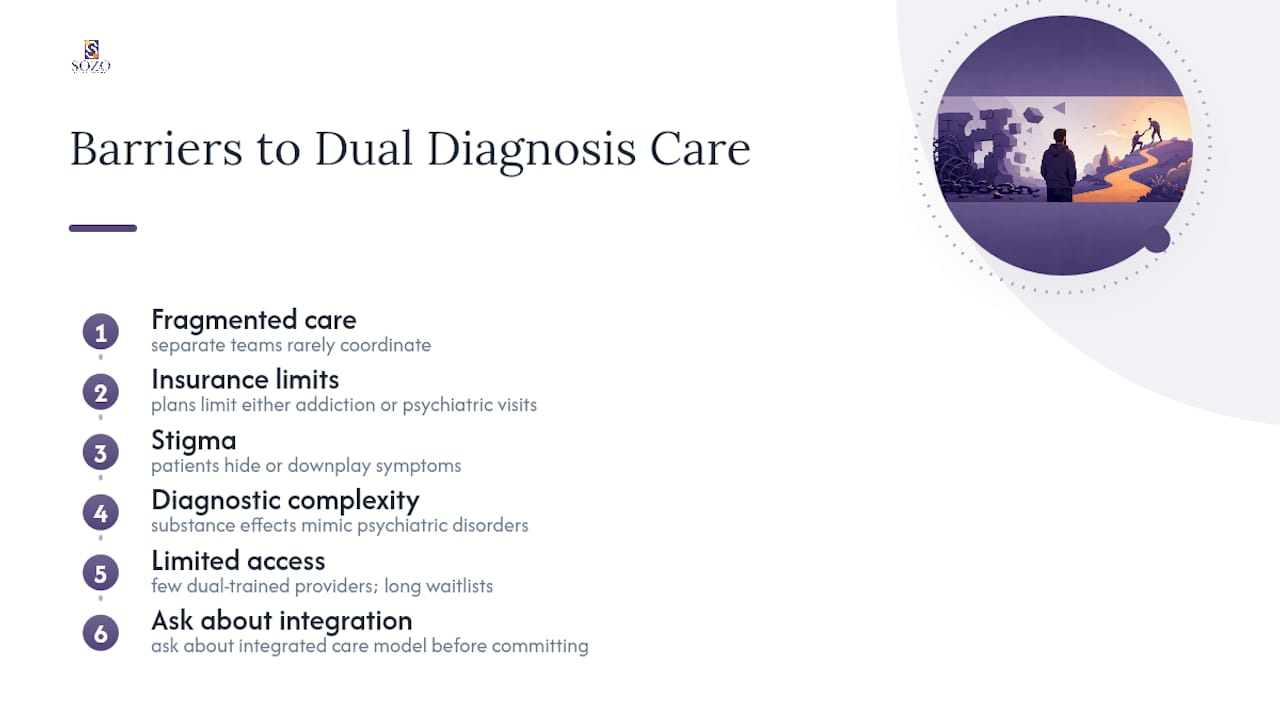
Plenty of programs still treat addiction and mental illness as two separate problems handled by two separate teams that rarely speak to each other. That fragmentation is the single biggest barrier standing between a man and lasting recovery, and it’s more common than most people realize.
Insurance coverage adds another layer of friction. Some plans cover addiction treatment robustly but limit psychiatric visits, or the reverse, forcing patients to bounce between providers who never coordinate care. Stigma compounds the problem on both sides. A man might hide his drinking from his psychiatrist out of shame, or downplay his depression to an addiction counselor because he thinks it will make him look weak or unfit for treatment.
Diagnostic complexity is real too. Substance withdrawal can look like generalized anxiety disorder. Chronic stimulant use can produce symptoms nearly indistinguishable from schizophrenia for weeks. Getting the diagnosis right takes time, patience, and a clinician willing to watch symptoms evolve rather than rushing to a label in the first visit.
Then there’s access. Rural areas often lack any provider trained in both addiction medicine and psychiatry, let alone a coordinated program. Waitlists for specialized dual diagnosis beds can stretch for weeks, a dangerous gap for someone in active crisis. None of these barriers are reasons to give up on treatment. They’re reasons to be deliberate about which program you choose and how directly you ask about their integration model before you commit.
What Long-Term Recovery From Dual Diagnosis Looks Like
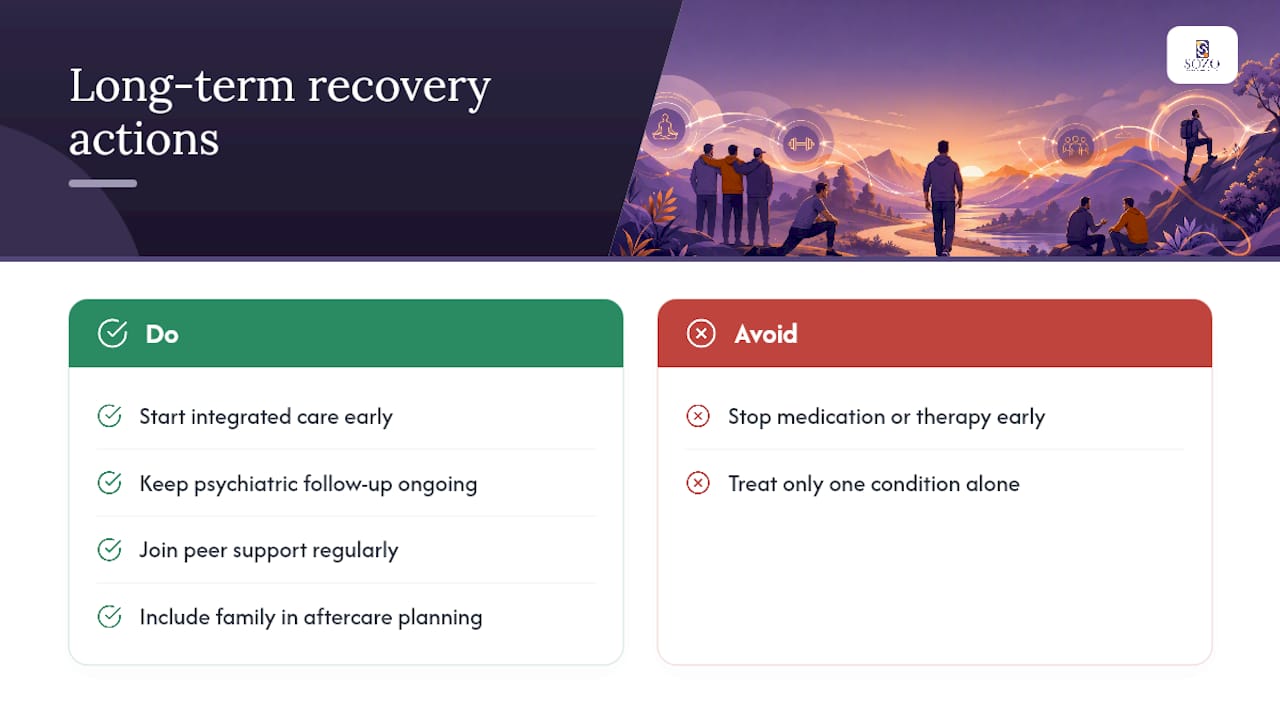
Prognosis for dual diagnosis varies by diagnosis pair, severity, and how early treatment starts, but the pattern research keeps confirming is this: men who receive integrated care from the outset have measurably better odds of sustained recovery than those treated for one condition while the other goes unaddressed.
Recovery from dual diagnosis is rarely linear. A man may go months feeling steady, then hit a stretch where a depressive episode reawakens old cravings, or a stressful season at work reopens anxiety that had gone quiet. That’s not failure. It’s the expected shape of managing two chronic conditions simultaneously, and it’s why long-term management looks less like a finish line and more like an ongoing practice.
The strategies that hold up over years share a few common threads. Continued psychiatric follow-up matters even after addiction symptoms stabilize, since stopping medication or therapy the moment things feel better is one of the most common paths back to relapse. Peer support, whether through 12-step meetings, faith communities, or both, gives men a place to name what’s happening before it spirals. Family involvement in aftercare planning consistently correlates with better outcomes, because recovery rarely holds when it happens in isolation from the people closest to a man’s daily life.
Sober living environments and step-down outpatient care bridge the gap between structured treatment and full independence, giving men a chance to practice new coping tools with a safety net still in place. The goal isn’t perfection. It’s building a life sturdy enough to absorb the inevitable hard weeks without collapsing back into old patterns.
How Dual Diagnosis Reaches Into Every Part of Life
Untreated co-occurring disorders rarely stay contained to the person experiencing them. They ripple outward into marriages, friendships, careers, and households, often long before anyone names what’s actually happening.
At work, the effects show up as missed deadlines, unexplained absences, or a slow erosion of trust with supervisors who don’t know about the depression or anxiety underneath the drinking. Job loss frequently follows, which then removes the income and structure that made recovery feel possible in the first place, a cruel feedback loop that’s hard to break without outside intervention.
At home, families often describe a slow unraveling rather than a single crisis. A wife notices her husband withdrawing emotionally before she notices the empty bottles. Kids sense the tension without understanding its source. Trust erodes in small increments, an unreturned call here, a broken promise there, until the relationship feels unrecognizable from where it started. Financial strain compounds all of it, since both untreated mental illness and active addiction tend to drain savings, damage credit, and sometimes end in legal consequences that follow a man for years.
Socially, isolation sets in fast. Friends who don’t understand the dual nature of the struggle drift away, sometimes out of frustration and sometimes out of their own discomfort. Men frequently describe feeling like they’re living two separate secrets at once, hiding the substance use from people who know about the depression, and hiding the depression from people who know about the drinking. That double concealment is exhausting, and it’s one more reason integrated treatment matters. It gives a man one place to be honest about the whole picture instead of managing two half truths.
A Perspective From SOZO Recovery Center
At SOZO Recovery Center, we’ve built our program around the ASAM Continuum specifically because clinical rigor and spiritual renewal aren’t competing priorities. For some men, faith gives the evidence-based work a foundation it didn’t have before. Still, every treatment plan should be tailored by a qualified clinician to the individual in front of them.
— Ty
Faith-Based Dual Diagnosis Care for Men at SOZO
If you’ve recognized your own story somewhere in these examples, know there’s a path forward that doesn’t ask you to choose between clinical care and your faith. A recovery center offers men-only residential and outpatient dual diagnosis programs built on personalized, ASAM-informed treatment plans that pair evidence-based therapy with biblical principles and the 12-step model.
Every plan starts with an honest look at both the addiction and the mental health condition underneath it, not just the surface behavior. Our dual diagnosis program integrates psychiatric care, individual counseling, and spiritual mentorship into a single coordinated plan, so nothing falls through the cracks between providers.
If you or someone you love is ready to talk, start the admissions process with a confidential call. Our team will walk through your situation, answer your questions honestly, and explain what the first thirty days actually look like before you commit to anything.
Sources
- Substance use and mental health | CDC
- Dual Diagnosis (Co-Occurring Disorders) – Cleveland Clinic
- Co-Occurring Disorders and Other Health Conditions | SAMHSA
- Substance use and mental health | National Institute of Mental Health (NIMH)
This article is general information, not a substitute for advice from a qualified doctor. Consult a qualified healthcare professional about your own circumstances before acting on anything here.
FAQ
What is an example of a dual diagnosis?
Major depressive disorder combined with alcohol use disorder is one of the most common examples, alongside PTSD with opioid use disorder and bipolar disorder with stimulant misuse.
What are the effects of dual diagnosis?
Co-occurring disorders tend to intensify each other’s symptoms, mask accurate diagnosis, and raise the risk of relapse, overdose, and serious disruption to work and family life.
What are the benefits of dual diagnosis treatment?
Treating both conditions together, rather than one at a time, is linked to better long-term recovery outcomes because it addresses the root causes driving both the addiction and the mental health condition, an approach SOZO Recovery Center builds into every personalized treatment plan.
What is the dual diagnosis model of addiction?
The dual diagnosis model recognizes that addiction and mental illness often develop together through self-medication, substance-induced changes, or shared vulnerabilities like trauma, which is why integrated care treats both simultaneously instead of sequentially.